.svg)


Dynamics 365 Implementation in Saudi Arabia: Step-by-Step Guide for 2026

Implementing Dynamics 365 in Saudi Arabia is not the same as implementing it anywhere else. The regulatory environment is specific, the compliance obligations are active, and the organisational risks are real. Businesses that treat this as a standard ERP project — scoping from a software catalogue rather than a business readiness baseline — consistently run into the same problems: ZATCA onboarding delays, Arabic localisation gaps discovered late, and go-live dates that slip because the organisation was never prepared to absorb the change.
This guide is for CFOs, COOs, IT Directors, and Finance Managers who are actively planning or evaluating a Dynamics 365 implementation in Saudi Arabia. It covers what implementation actually involves, what it costs, how long it takes, what Saudi-specific requirements you must address, and — critically — what separates a successful implementation from one that stalls.
Direct answer: A Dynamics 365 implementation in Saudi Arabia typically takes 6 to 12 months for mid-market scope and 12 to 24 months for enterprise programmes. Implementation services typically range from SAR 400,000 to SAR 1,500,000 for mid-market and SAR 1,500,000 to SAR 4,000,000 or more for enterprise. Saudi-specific requirements — including ZATCA Phase 2 e-invoicing, VAT at 15%, Arabic localisation, and Saudization tracking — must be designed into the system from the start, not added after go-live.
What Makes Dynamics 365 Implementation Different in Saudi Arabia
Saudi Arabia has a compliance environment that directly shapes how Dynamics 365 must be configured. These are not optional localisation preferences. They are regulatory obligations that affect your chart of accounts, your invoice architecture, your HR module setup, and your data infrastructure before a single user logs in.
Why Vision 2030 Is Accelerating This Decision
Saudi Arabia's Vision 2030 programme is creating real urgency for ERP modernisation across both public and private sectors. Organisations aligning their Dynamics 365 implementation with Vision 2030 goals — automation, real-time financial visibility, reduced manual processes — tend to secure stronger executive sponsorship and, in some cases, government-backed incentives for technology investment.
The practical implication: frame your implementation business case around measurable outcomes (faster financial close, ZATCA compliance, improved procurement visibility) rather than technology features. That language resonates with steering committees and with the broader Vision 2030 narrative your organisation is likely already navigating.
How Much Does Dynamics 365 Implementation Cost in Saudi Arabia?
Implementation cost is the question most buyers ask first and most guides avoid answering. Here are realistic ranges based on Saudi market delivery experience.
These figures cover implementation services only. Microsoft licensing is separate.
Licensing Costs
- Dynamics 365 Finance and Operations: USD 180 to USD 210 per user per month (verify current pricing at Microsoft's Dynamics 365 pricing page)
- Dynamics 365 Business Central Essentials: USD 80 per user per month
For a 100-user Finance and Operations deployment, licensing alone runs USD 18,000 to USD 21,000 per month before implementation services are factored in.
What Drives Cost Up in Saudi Arabia
Generic implementation guides ignore the Saudi-specific cost layers. These are the ones that matter:
The honest advice: separate your budget into three buckets — Microsoft licensing, implementation services, and a contingency of 15 to 20 percent for scope that emerges during discovery. Organisations that do not budget for contingency consistently run into fixed-price disputes with their implementation partner.
For a detailed cost breakdown, see the Dynamics 365 Implementation Cost in Saudi Arabia guide.
How Long Does Dynamics 365 Implementation Take in Saudi Arabia?
Timeline depends on scope, data quality, and organisational readiness — not just the number of modules selected. These are realistic ranges, not vendor marketing estimates.
- Scope: Mid-market (Finance + one additional module, standard integrations) — Typical Timeline: 6 to 12 months
- Scope: Enterprise (multi-entity, complex integrations, full suite) — Typical Timeline: 12 to 24 months
- Scope: AX 2012 to Dynamics 365 migration (with customisation debt) — Typical Timeline: 9 to 18 months
What Extends Timelines in Saudi Projects
- ZATCA onboarding delays — The CSID procurement and compliance environment testing process has dependencies and approval cycles that cannot be compressed. Starting ZATCA onboarding in parallel with functional configuration is not optional; starting it late is one of the most common causes of go-live delays in Saudi implementations
- Data quality issues — Organisations that have been running on legacy systems for years typically discover more data problems than expected. A data audit that should take two weeks often takes six
- Customisation scope creep — Every custom development item adds build, test, and regression time. Projects that start with "a few customisations" and end with forty are the norm, not the exception
- Executive decision speed — Delayed approvals on process design decisions, data migration sign-offs, and UAT acceptance are consistently the largest unplanned timeline risk in Gulf region implementations
- Change management readiness — Organisations that have not prepared their people for the change consistently require more training cycles, more UAT iterations, and longer hypercare periods
The most important timeline insight: the organisations that complete on time are almost always the ones that completed a readiness assessment before the project started — not after scope was locked and the clock was running.
The Transformation-Led Implementation Framework: Step by Step
Most implementation guides present a linear technical checklist. The problem is that technical checklists do not account for the organisational conditions that determine whether the technology actually works once deployed. The framework below integrates the technical delivery stages with the organisational readiness work that must happen in parallel.
This is the approach Terracez applies through its Transformation Intelligence methodology — assessing executive alignment, governance, business readiness, and operating model clarity before configuration begins, not after go-live problems surface.
Stage 1: Business Case and Readiness Assessment
What happens: Before a scope document is written, the organisation must establish why it is implementing Dynamics 365, what measurable outcomes it expects, and whether it is actually ready to absorb the change.
Who owns it: Executive sponsor, CFO or COO, supported by the implementation partner's advisory lead.
Key deliverables:
- Defined business outcomes (not technology features): faster financial close, ZATCA compliance, improved procurement visibility, Saudization reporting accuracy
- Executive alignment on scope, investment, and governance structure
- Readiness assessment across six dimensions: stakeholder alignment, process maturity, data quality, integration clarity, change capacity, and governance
What to ask your partner: Can you assess our organisational readiness before we lock scope and price? A partner that moves straight to scope and proposal without a readiness conversation is optimising for their sales cycle, not your implementation outcome.
Terracez readiness signal: Terracez conducts an Alignyx readiness assessment before every implementation engagement — evaluating process maturity, data quality, and stakeholder alignment before a project scope is fixed. This is not a sales exercise. It is the evidence base for a realistic proposal.
Stage 2: Scope Definition and Module Selection
What happens: Based on the business case, define which Dynamics 365 modules are in scope, which business processes they will cover, and what the phasing looks like.
Key modules for Saudi organisations:
The most common scoping mistake: attempting to go live with every module simultaneously. Phased delivery — Finance first, then Supply Chain, then HR — consistently produces better adoption and lower risk than a big-bang approach.
Stage 3: Data Audit and Migration Strategy
What happens: Audit source data, cleanse it, map it to Dynamics 365 data structures, and run parallel migration testing before go-live.
Saudi-specific data considerations:
- Historical VAT records must be migrated accurately — ZATCA audits can cover prior periods
- Arabic and English dual-language records for customers, vendors, and items require careful mapping
- Hijri date conversions for historical HR and contract records
- Open purchase orders and invoices from the legacy system need structured cutover planning
Use Microsoft's Data Migration Toolkit throughout. It enforces data accuracy standards that reduce post-go-live data quality issues. Never migrate directly to production — run full migration tests in a sandbox and have business users sign off before cutover.
Stage 4: ZATCA Configuration and Saudi Localisation
What happens: Configure the compliance layer that makes Dynamics 365 legally operable in Saudi Arabia. This stage must run in parallel with functional configuration — not after it.
ZATCA Phase 2 configuration steps:
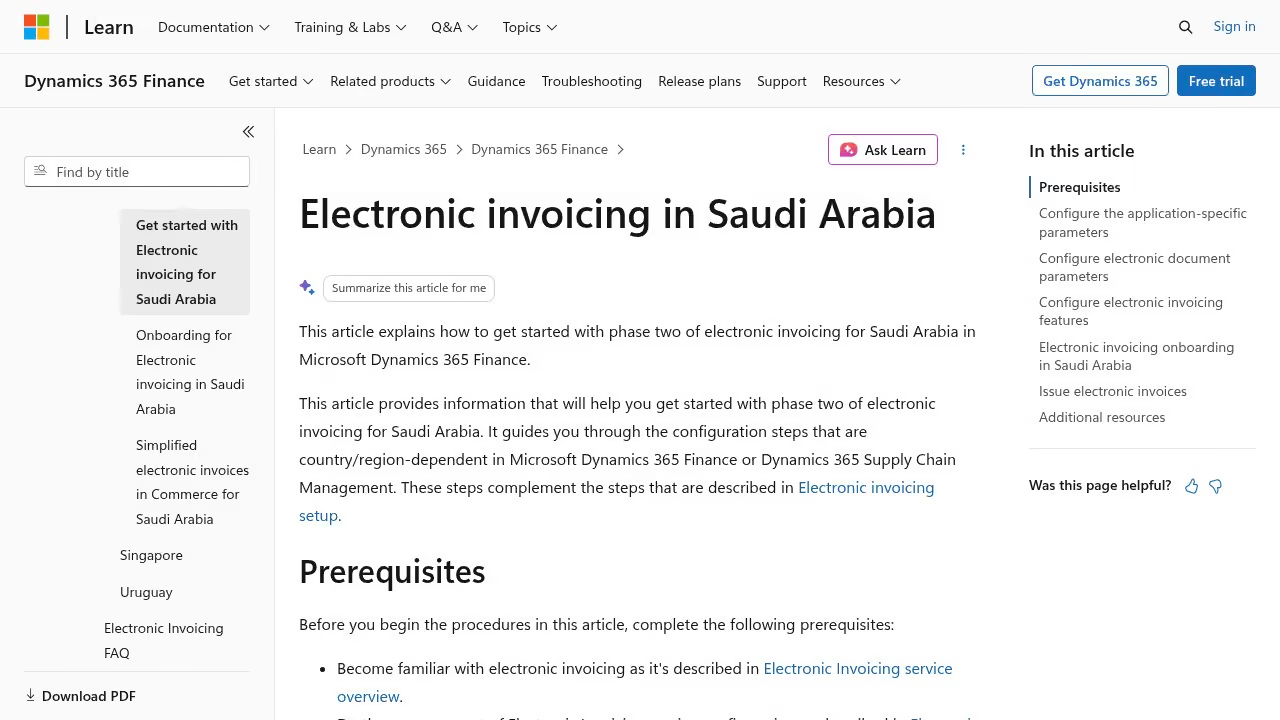
- Onboard with ZATCA to obtain Compliance CSIDs (CCSID) for testing and Production CSIDs (PCSID) for live transactions — see Microsoft's ZATCA onboarding guide
- Import the Saudi Arabian Zatca submission feature (version 14 or later) from the Globalization Studio repository
- Configure the Fatoora API endpoint in the Feature parameters tab, including ZatcaNumberSequence and response type mappings
- Set up QR code generation for tax invoices — ZATCA generates these upon clearance and they must be imported back into Finance
- Test in ZATCA's compliance environment before deploying to production
Additional localisation requirements:
- VAT configuration: 15% standard rate, zero-rated exports, reverse charge for imported services
- Arabic UI and bilingual document templates for invoices, purchase orders, and financial statements
- Saudization ratio tracking configuration in the HR module
- Hijri calendar support in HR and payroll
Critical point from delivery experience: partners who defer ZATCA configuration to the final weeks of a project consistently create compliance risk at go-live. If ZATCA e-invoicing workflows are not tested end-to-end before cutover, the system can go live with invoice-validity or audit exposure risk. Start ZATCA onboarding on day one of the project.
Stage 5: Build, Integration, and Testing
What happens: Configure modules, build integrations, and run three levels of testing before go-live.
Testing levels:
- Unit testing: Individual configuration elements tested by functional consultants as they build
- Integration testing: End-to-end process flows tested across modules (purchase order through to VAT-compliant ZATCA submission)
- User Acceptance Testing (UAT): Business users test real scenarios from their daily workflows and sign off
Saudi UAT must specifically include:
- ZATCA e-invoice generation, submission, and QR code return
- VAT return report accuracy across transaction types (standard, zero-rated, reverse charge)
- Arabic document printing and bilingual invoice output
- Saudization ratio reporting (if HR is in scope)
Integration architecture for Saudi businesses typically includes: GOSI, WPS, banking system integration, and Muqeem for expatriate tracking. Each of these requires separate API design, testing, and sign-off. Do not treat them as afterthoughts.
Stage 6: Training, Change Management, and Go-Live
What happens: Prepare people for the change, execute cutover, and monitor the first 90 days.
Training delivery for Saudi organisations:
- Role-based sessions by department — not generic system walkthroughs
- Bilingual delivery (Arabic and English) — English-only training materials are insufficient for organisations where a significant portion of the workforce operates in Arabic
- Designated super users in each department who can support colleagues post-launch
- Quick reference guides in both languages
Change management is not a training programme. It is a sustained communication and engagement effort that starts at project initiation, not at go-live. Involve department heads from the discovery phase. Communicate what is changing, why it is changing, and what the organisation will be able to do that it cannot do today. Resistance to change — not technical failure — is what causes most implementations to underdeliver.
Cutover planning essentials:
- Define a clear cutover date and freeze period for legacy system transactions
- Migrate opening balances on a specific date and validate against source records
- Run the legacy system in parallel for 2 to 4 weeks to validate D365 outputs
- Have your implementation partner on standby during the first week of live operations
Stage 7: Hypercare and Value Realisation
What happens: The first 90 days after go-live are when real-world usage reveals gaps that testing did not catch. This stage is where the return on investment is either secured or squandered.
Post-go-live priorities for Saudi Arabia:
- Monitor ZATCA submissions closely — verify invoices are being cleared by Fatoora, QR codes are returning correctly, and no submission errors are occurring
- Review the first VAT return period outputs against your accountant's expectations before submission
- Track system usage by department — low login rates or high error rates signal training gaps that must be addressed before bad habits become entrenched
Go-live is not the finish line. Dynamics 365 releases major updates twice a year. Build a post-go-live roadmap that includes regular review of new features, expansion into additional modules as confidence grows, Power BI integration for management reporting, and Power Automate workflows to eliminate manual processes identified after go-live.
For guidance on what a strong post-go-live support model looks like, see the Dynamics 365 Support in Saudi Arabia: SLA Guide.
Common Implementation Risks and How to Reduce Them
The same risks appear across Dynamics 365 projects in Saudi Arabia. Knowing them in advance is the most cost-effective form of risk management available to a CFO or COO.
The risk that most guides miss: the biggest implementation risks are organisational, not technical. A technically correct system that the organisation was never prepared to absorb is a failed implementation regardless of what the go-live report says. Readiness assessment before scope lock is the most reliable way to surface these risks while there is still time to address them.
See also: Why Dynamics 365 Implementations Fail — and How to Choose a Partner That Won't
How to Choose a Dynamics 365 Implementation Partner in Saudi Arabia
Partner selection is where most implementations are won or lost — before configuration begins. The right partner reduces your risk. The wrong one creates it.
The Seven Criteria That Matter
- Microsoft Solutions Partner for Business Applications status — Verify this directly through the Microsoft Partner Centre. This designation confirms validated delivery capability, not just a sales relationship with Microsoft.
- ZATCA Phase 2 delivery evidence — Ask for named client references where the partner has configured and gone live with ZATCA Phase 2 e-invoicing integration. Claims are not evidence. Reference calls are.
- Saudi Arabia delivery experience in your industry — A partner with Dynamics 365 experience in European manufacturing is not the same as one with experience in Saudi contracting, petrochemical, or distribution. Ask for references in your sector.
- Arabic localisation capability — Can they deliver bilingual training, Arabic-language UAT documentation, and Arabic report design? Ask to see examples, not assurances.
- Implementation methodology — Do they follow Microsoft's Success by Design framework? Do they conduct a structured discovery before proposing a price? A partner that quotes without discovery is guessing at your scope.
- Readiness assessment capability — Does the partner assess your organisational readiness before configuring your system? This is the single clearest differentiator between a transformation-led partner and a technology-only implementor.
- Post-go-live support model — What does their hypercare period look like? What are their SLA commitments? Do they have local support capability in Saudi Arabia?
CIOs should demand proof of delivery in their vertical, with named examples for the same modules and business processes they plan to implement. Claims of "extensive Saudi experience" without reference cases are a red flag, not a credential.
For a full partner evaluation framework, see How to Choose a Dynamics 365 Partner in Saudi Arabia and the Dynamics 365 Partners in Riyadh: 2026 Buyer's Guide.
Frequently Asked Questions
How much does Dynamics 365 implementation cost in Saudi Arabia?
Implementation services typically range from SAR 150,000 to SAR 400,000 for small or limited-scope projects, SAR 400,000 to SAR 1,500,000 for mid-market deployments, and SAR 1,500,000 to SAR 4,000,000 or more for enterprise programmes. Saudi-specific requirements — ZATCA configuration, Arabic localisation, and local integrations such as GOSI and WPS — add cost that generic guides do not account for. Microsoft licensing is separate.
How long does a Dynamics 365 implementation take in Saudi Arabia?
Mid-market implementations typically take 6 to 12 months. Enterprise programmes with multiple entities and complex integrations typically take 12 to 24 months. The most common causes of timeline overrun are ZATCA onboarding delays, data quality issues discovered late, and executive decision speed — not technical complexity.
Can Dynamics 365 support ZATCA Phase 2 e-invoicing requirements?
Yes. Dynamics 365 Finance supports ZATCA Phase 2 integration natively, including XML invoice generation, Fatoora API integration, CSID onboarding, and QR code return. Configuration must be done correctly from the start — deferred ZATCA setup is one of the most common causes of compliance risk at go-live.
What is the difference between Dynamics 365 Finance and Business Central?
Dynamics 365 Finance and Operations is designed for large, complex enterprises with multi-entity structures, advanced supply chain requirements, and high transaction volumes. Business Central is designed for mid-market organisations that need an integrated ERP without the full complexity of F&O. The right choice depends on your organisation's scale, process complexity, and growth trajectory.
What internal team do I need for a Dynamics 365 implementation?
At minimum: an executive sponsor who owns the business case and resolves escalations, a project manager for day-to-day delivery oversight, business subject matter experts (process owners) for each functional area in scope, a change management lead, and a data migration owner. The business must be actively involved — implementations led entirely by IT without business process ownership consistently underdeliver.
What happens after Dynamics 365 goes live?
The first 90 days are hypercare: monitor ZATCA submissions, validate VAT return outputs, track user adoption by department, and address training gaps quickly. After hypercare, build a continuous improvement roadmap covering new module adoption, Power BI reporting, Power Automate workflows, and Microsoft's twice-yearly release wave updates.
How do I assess whether my organisation is ready for Dynamics 365?
Assess six dimensions before locking scope: stakeholder alignment, process maturity, data quality, integration clarity, change capacity, and governance. Low scores in any dimension should become funded preparation activities — not hidden implementation assumptions. See the Dynamics 365 Implementation Readiness Checklist for a practical starting framework.
Ready to Plan Your Dynamics 365 Implementation in Saudi Arabia?
Most implementation problems are predictable. The organisations that avoid them assess their readiness before selecting a partner — not after scope is locked and the clock is running.
Terracez is a certified Microsoft Solutions Partner for Business Applications with Dynamics 365 delivery experience across Saudi Arabia and the wider GCC. Our approach begins with a structured readiness assessment — evaluating executive alignment, process maturity, data quality, and governance before a single configuration decision is made.
Clients include SIRC, where Terracez implemented a scalable Dynamics 365 F&O platform that unified finance, procurement, inventory, and customer service operations to support Saudi Arabia's circular economy goals, and Arnon, where a unified ERP platform connected finance, production, inventory, and sales to improve efficiency and support future growth.
Request a Dynamics 365 Implementation Readiness Assessment to understand your scope, identify your compliance obligations, and receive a realistic cost and timeline estimate before you commit to a partner.
No obligation. No sales process. A structured conversation with a senior Terracez advisor about your implementation priorities.
Start Your Readiness Assessment
Related Terracez guidance:
Answers that help you move forward with confidence
Your brand deserves powerful design that delivers measurable results.