.svg)


Manufacturing Transformation Requires Operational Clarity Before System Configuration


The Manufacturing Challenge
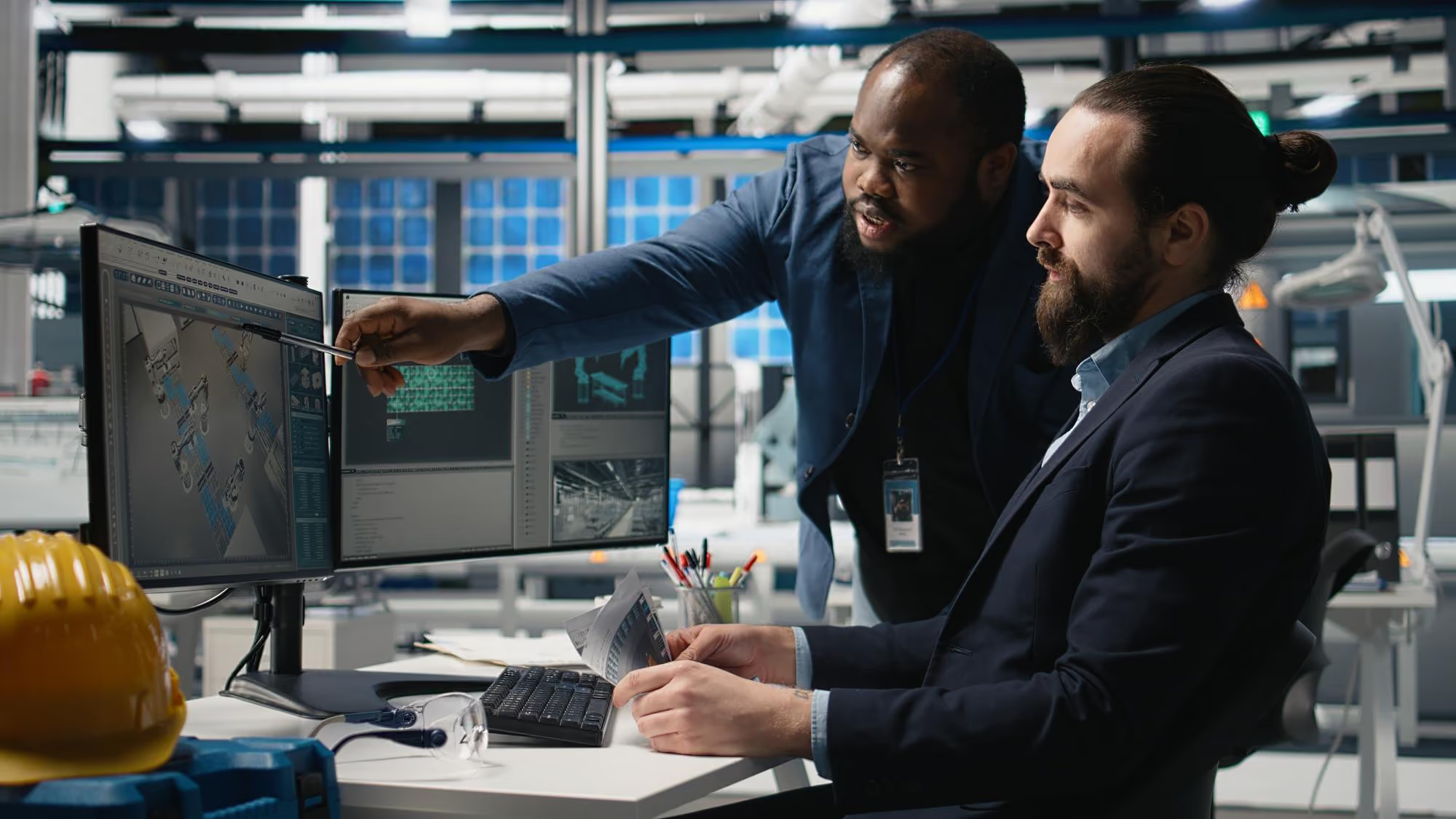
Manufacturing organisations in Saudi Arabia and the GCC are under increasing pressure to modernise. Vision 2030's industrial diversification agenda, growing competition, and the need for supply chain resilience are driving investment in ERP and operational technology. The investment is real. The outcomes are inconsistent. Manufacturing ERP programmes fail for reasons that have nothing to do with the software. Production planning ownership is unclear. The relationship between procurement, inventory, and production scheduling is poorly governed. Master data — bills of materials, routings, item masters — is incomplete or inaccurate. The operating model for how manufacturing decisions are made was never redesigned before the system was configured. The result is a system that automates existing inefficiency rather than enabling a better operating model.
What Transformation Looks Like in Manufacturing
Production planning inefficiency
No integrated view of demand, capacity, and material availability

Inventory accuracy
Stock records that do not reflect physical reality, causing production delays

Procurement and supply chain fragmentation
Purchasing decisions disconnected from production requirements
Quality management
No structured quality governance across production and supplier inputs
Need batch, ingredient or recall traceability? Explore Dynamics 365 for Food & Beverage
Cost visibility
Production cost tracked manually, with no real-time view of cost per unit or batch

Maintenance and asset downtime
Reactive maintenance with no predictive capability or structured asset history

Executive operational reporting
Leadership receives operational data too late to act on it

How Terracez Works With Manufacturing Organisations
Terracez works with manufacturing organisations across the full transformation lifecycle — establishing operational clarity before implementation, governing execution around the agreed production model, and monitoring performance and adoption after Go-Live.
Before Implementation Begins
- Executive alignment on manufacturing transformation objectives is confirmed across operations, finance, and supply chain leadership
- The production operating model is defined: planning ownership, scheduling governance, and quality accountability
- Master data quality is assessed: bills of materials, routings, item masters, and supplier records
- Integration requirements between production, procurement, finance, and maintenance are mapped
- Workforce capability and change readiness across the production floor are evaluated
During Implementation
- Production planning structures, cost models, and quality workflows are configured around the agreed operating model.
- Bills of materials and routing structures are validated before configuration begins.
- Customisation is minimised to protect upgrade paths.
After Go-Live
- Terracez monitors production KPI performance, inventory accuracy, and user adoption across operations and back-office teams through the Alignyx platform.
- Continuous improvement of the production operating model is governed as a structured programme discipline.
Dynamics 365 Applications for Manufacturing
Manufacturing Sectors and Operating Models Terracez Serves
Terracez delivers Dynamics 365 manufacturing programmes across the following sectors and operating models in Saudi Arabia, the UAE, and the wider GCC:
Sector
Operating Model
Typical Complexity
Food and beverage
Process manufacturing
Halal compliance, lot traceability, batch genealogy, recipe governance
Plastics and packaging
High-volume process
Batch traceability, quality compliance, yield visibility, procurement automation
Discrete manufacturing
Make-to-stock, make-to-order
Multi-level BOM, engineering change, capacity planning, production costing
Fabrication and engineered manufacturing
Engineer-to-order
Complex BOM, routing, subcontracting, quality certification
EPC and project-based manufacturing
Project manufacturing
Project cost control, milestone billing, procurement linked to WBS
Petrochemical and industrial processing
Process manufacturing
Formula management, co-product tracking, regulatory compliance
Multi-site manufacturing groups
Mixed model
Multi-entity consolidation, intercompany transactions, cross-border governance
Who Terracez is the right fit for
Terracez does not position itself as the right partner for every manufacturer. The Alignyx readiness assessment exists to determine whether the fit is genuine before commercial commitments are made.

Why Manufacturing Organisations Choose Terracez




What Terracez Delivers: Full Scope Across the Manufacturing Transformation Lifecycle
Terracez is a certified Microsoft Solutions Partner for Business Applications. That credential is the starting point. What it does not convey is the scope of what Terracez delivers across a manufacturing transformation, from the first readiness conversation to post-go-live operational improvement.

Advisory and readiness (before implementation begins)
• Alignyx manufacturing readiness assessment: executive alignment, governance maturity, operating model clarity, and adoption readiness
• Production process mapping across planning, procurement, quality, inventory, maintenance, and finance
• Data quality profiling across item masters, BOMs, routes, supplier records, and cost structures
• Fixed-price proposal based on validated scope
Implementation and configuration
• Dynamics 365 Finance and Supply Chain Management or Business Central
• Power BI: production dashboards, OEE reporting, procurement analytics, and executive visibility
• Power Automate: procurement approval workflows, quality alert routing, and supplier notification
• Power Apps: shop-floor data capture, inspection checklists, and mobile warehouse operations
• Azure AI and Copilot: demand forecasting, predictive maintenance, and procurement intelligence
• Integration with MES, WMS, banking, payroll, logistics, and third-party systems
Post-go-live
• 24/7 managed support with defined SLAs and manufacturing-specialist coverage
• Alignyx continuous monitoring of adoption rates, process compliance, and production KPIs
• Structured continuous improvement programme governed as a programme discipline
Is Your Manufacturing Organisation Ready to Transform?
A structured conversation with a senior Terracez advisor about your production operations, supply chain governance, and transformation readiness. No obligation. No sales process.

Trusted by brands across industries

"Terracez helped us to achieve the business critical requirement of upgrading AX 2012 to D365 within our timelines. It was important for us to completely upgrade in 2 months which they achieved well before, where other MS partners told was not possible to do."
"Terracez team is a great consultancy, which follows an agile approach to solve any kind of business issues. We are adding a lot of automation with their experienced and highly-skilled team in the manufacturing domain."
"We wanted a partner to support in transitioning SATS’ processes to comply with the new regulation quickly. Terracez understood our business and helped us in enabling the process efficiency without compromising on compliance."

Is Your Manufacturing Organisation Ready to Transform?
Every engagement begins with a structured conversation about operational priorities — not a system demonstration.