


In brief: Assess stakeholder alignment, process maturity, data, governance and change readiness before asking a Dynamics 365 partner for scope and pricing.
The question most GCC enterprises ask when planning a Dynamics 365 implementation is the wrong one. "Who should I contact?" assumes the organisation is ready to be implemented. The data suggests otherwise.
According to Gartner, 55% to 75% of ERP projects fail to meet their objectives. For Dynamics 365 specifically, approximately 60% of implementations don't deliver the ROI organisations expected when they signed the contract.
What's striking about that figure is the reason behind it. The failures are rarely caused by the technology. They are rarely caused by choosing the wrong partner. The root cause, consistently, is organisational unreadiness: fragmented stakeholder alignment, unclear governance, undocumented processes, and integration complexity that nobody mapped before capital was committed.
This article doesn't answer "who to contact." It answers the question you should ask first: is your organisation actually ready to implement? The five diagnostic questions below are what every CIO and digital transformation leader in the UAE and GCC should be able to answer with confidence before a single vendor conversation takes place. If you can't answer them clearly, you're not ready. And contacting an implementation partner before you're ready is how a AED 5 million project becomes a AED 15 million one.
Why GCC Enterprises Are Particularly Exposed
The Middle East and Africa region is now the fastest-growing market for Dynamics 365, with a projected CAGR of 13.48% through 2030. Saudi Vision 2030 has embedded ERP adoption directly into national policy. The UAE Digital Government Strategy is pushing enterprises toward digital transformation on accelerated timelines. This momentum is real, and the competitive window is genuine. But speed without preparation is precisely how large-scale failures are created.
GCC industrial enterprises carry a specific set of risk amplifiers that make unpreparedness more costly here than in more mature ERP markets. Organisations running legacy ERP systems typically spend 70% of their IT budgets maintaining existing infrastructure, leaving minimal capacity to absorb the disruption of a failed transformation. Add to that the multi-entity complexity common across manufacturing, EPC, and construction groups operating across Saudi Arabia, the UAE, and wider GCC markets, and the conditions for a costly misalignment are already in place before a vendor is selected.
Three factors compound this risk specifically for the region:
- Regulatory complexity: ZATCA e-invoicing compliance, UAE VAT reporting, and Wages Protection System (WPS) requirements must be validated during implementation design. Misaligned requirements discovered mid-implementation create costly rework.
- Legacy infrastructure debt: Organisations with heavily customised legacy ERP systems face integration complexity that is rarely visible until discovery begins. Discovering it mid-project is where budgets break.
- Multi-entity organisational structures: Large GCC enterprise groups operating across multiple subsidiaries and geographies require cross-entity stakeholder alignment that generic implementation approaches consistently underestimate.
The 5 Questions to Answer Before You Contact an Implementation Partner
These are not abstract strategy questions. They are the exact dimensions that determine whether a Dynamics 365 implementation succeeds or fails. According to Panorama Consulting's 2025 ERP Report, 42% of failures stem from inadequate change management, 31% from lack of executive sponsorship, and 26% from scope creep. Every one of those root causes maps directly to a question below. If you cannot answer these with confidence, you have identified your risk before it costs you.
Question 1: Do Your Stakeholders Agree on What This Implementation Needs to Achieve?
Stakeholder misalignment is the single most common hidden cause of implementation failure. It rarely surfaces until the project is underway, at which point resolving conflicting requirements means expensive rework, scope changes, and timeline extensions. Before any vendor conversation, you need a clear, documented answer.
Ask yourself:
- Can your Finance, Operations, Supply Chain, and IT leads each articulate the same top three business outcomes from this implementation?
- Are there departments that have been excluded from requirements discussions so far?
- Do you have documented evidence of stakeholder agreement, or is alignment assumed rather than verified?
Question 2: Does Your Organisation Have the Governance Structure to Own This Transformation?
Governance failure accounts for 31% of ERP project failures. An implementation without clear decision-making authority, executive sponsorship, and accountability frameworks will drift. Timeline pressure will force premature go-live decisions. Scope will expand without control. The Birmingham City Council Oracle project began with a £19 million budget and reached an estimated £216 million in total costs, a pattern driven by governance weakness, not technology failure.
Ask yourself:
- Is there a named executive sponsor with genuine authority to make and enforce decisions?
- Does your organisation have a defined escalation path for when departments disagree on requirements?
- Has a steering committee been constituted, with clear accountability for programme outcomes?
Question 3: Are Your Current Processes Documented and Consistently Executed?
ERP systems are designed to standardise and automate business processes. If those processes are undocumented, inconsistent across departments, or vary between entities in a group structure, the implementation will attempt to automate chaos. The result is a system that technically works but that nobody uses correctly, which is how you arrive at a 60% ROI failure rate without a single line of bad code.
Ask yourself:
- Are your finance, procurement, supply chain, and operations processes documented at a level that could be handed to an implementation team today?
- Do those processes vary significantly between business units or entities?
- Have process owners been identified and given accountability for their functional area during the implementation?
Question 4: Does Your Organisation Have the Change Management Capability to Absorb This?
Dynamics 365 fundamentally changes how teams work. It changes approval workflows, reporting structures, data entry patterns, and inter-departmental handoffs. Organisations that treat implementation as a purely technical rollout, and invest nothing in change management, see adoption rates collapse post go-live. The system works. Nobody uses it correctly. ROI never materialises.
Ask yourself:
- Has a change management plan been developed, or is training scheduled as a single event at the end of the project?
- Are there identified change champions in each department who will drive adoption from within?
- Does your organisation have prior experience managing large-scale technology transitions, and what were the adoption outcomes?
Question 5: Do You Understand the True Complexity of Your System Landscape and Integration Requirements?
Integration complexity is the most consistently underestimated dimension of ERP transformation. Organisations typically know their primary systems. They rarely have a complete picture of the downstream applications, custom integrations, data feeds, and legacy connections that will be affected by a new ERP. Discovering this complexity during implementation, rather than before it, is a primary driver of scope creep and budget overrun.
Ask yourself:
- Has a complete system landscape map been produced, covering all applications that exchange data with your current ERP?
- Are your data quality standards understood and documented, particularly for master data (customers, vendors, items, chart of accounts)?
- Have integration complexity and data migration effort been formally estimated, or are they still described as "to be scoped"?
What a Low Readiness Score Actually Costs You
The financial case for readiness assessment is straightforward. Panorama Consulting's 2025 ERP Report puts the average cost overrun at 189% across all industries. In manufacturing, that figure reaches 215%. A project budgeted at AED 5 million does not simply fail; it consumes AED 10 to 15 million before the organisation accepts the outcome and regroups. Forrester's Total Economic Impact study found that enterprises which entered Dynamics 365 Finance and Supply Chain implementation with structured preparation achieved USD 8.9 million in productivity gains over three years. The difference between that outcome and a failed project is not the technology. It is the preparation.
Dimension
Without Readiness Assessment
With Alignyx Pre-Assessment
Budget
189% average overrun; manufacturing reaches 215%
30-50% budget overruns avoided through early risk identification
Timeline
Discovery extends implementation by months; scope creep adds further delays
AI-guided discovery compresses requirements capture from months to weeks
Stakeholder Alignment
Conflicting requirements surface mid-implementation, forcing expensive rework
Alignment gaps identified and resolved before vendor selection begins
The table above is not a theoretical comparison. It reflects the consistent pattern across ERP implementations globally, and the specific financial protection that structured pre-assessment provides. Organisations that quantify their readiness before committing capital enter implementation with a validated scope, aligned stakeholders, and a risk profile their board can evaluate. Organisations that skip this step are not saving time. They are deferring the cost of discovery to the most expensive possible moment.
How Alignyx Answers These Questions Before You Commit
The five questions above are not a checklist to complete manually over several weeks of workshops. Alignyx is a transformation intelligence platform built specifically to answer them with measurable, board-ready outputs before vendor selection begins. It is not a consulting engagement. It is decision intelligence infrastructure that connects executives, project sponsors, business stakeholders, and IT leadership within a single structured environment, and produces quantified readiness metrics that eliminate the guesswork from capital commitment.
The platform operates through a structured five-step workflow. The executive sponsor initiates the assessment and defines scope. Stakeholders are assigned and activated across departments. AI-guided discovery conversations then capture operational pain points, process flows, data quality challenges, regulatory requirements, and future-state objectives from each function. The system structures those inputs into organised requirement intelligence, identifies conflicts and dependencies, and surfaces them for resolution. Executives then receive leadership dashboards, risk assessments, and a structured Business Requirements Document (BRD) that quantifies readiness before a single dirham is committed.
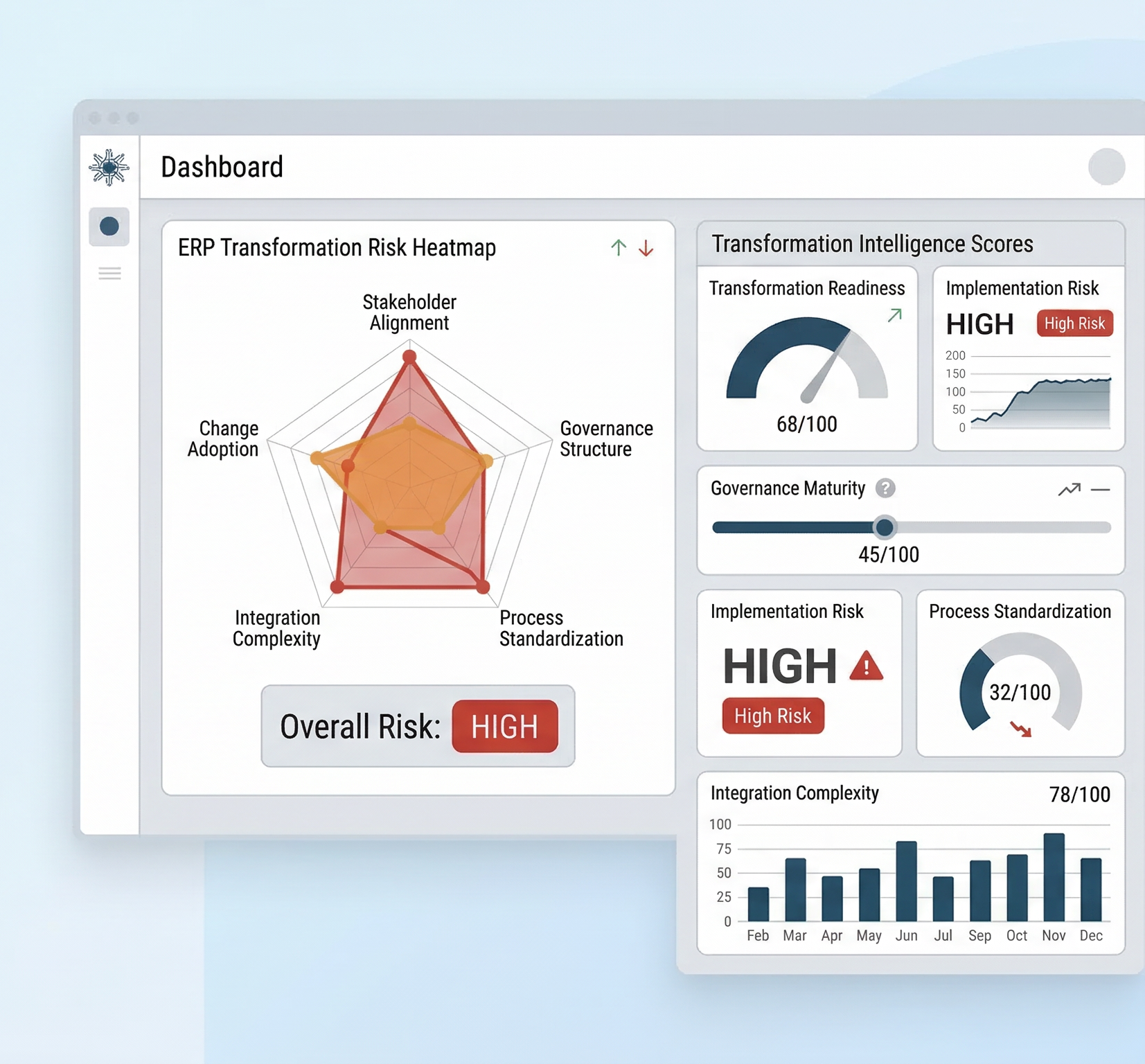
The outputs Alignyx delivers to leadership include:
- Transformation Readiness Score (0-100): A quantified assessment across all five dimensions, so leadership knows exactly where the organisation stands before committing capital.
- ERP Risk Heatmap: Visual risk mapping across stakeholder engagement, governance maturity, process clarity, organisational readiness, and transformation complexity.
- Stakeholder Alignment Index: Measures alignment gaps across departments and entities, identifying where conflicts must be resolved before implementation begins.
- Executive Intelligence Dashboard: Real-time visibility into participation, decision progress, and risk emergence for CIOs and steering committees.
The Right Sequence: Readiness First, Partner Second
The answer to "who should I contact for Dynamics 365 implementation?" is: start with a readiness assessment, then contact a partner. The correct sequence is not complicated. It is simply not what most organisations follow.
- Assess readiness: Use Alignyx to quantify your organisation's readiness across stakeholder alignment, governance maturity, process clarity, organisational capability, and transformation complexity. Understand your risk profile before any vendor sees your requirements.
- Structure requirements: Let the platform's AI-guided discovery produce a validated BRD. Enter vendor conversations with documented, conflict-resolved requirements rather than assumptions.
- Select your implementation partner with confidence: Clear requirements enable better vendor evaluation, more predictable scoping, and a partner relationship built on a shared understanding of what the project actually involves.
- Implement: With quantified readiness metrics, aligned stakeholders, and clear governance, your implementation partner can deliver. Terracez, as a certified Microsoft Catalyst partner with experience across 25+ brands in the UAE and GCC, is built for precisely this phase.
Organisations that follow this sequence enter implementation with confidence. Those that skip step one are not moving faster. They are building in the delays and overruns that will cost them later.
Request an Executive Discussion with Terracez to begin your Alignyx readiness assessment before your next vendor conversation.
Six dimensions of implementation readiness
- stakeholder alignment;
- process maturity;
- data quality and ownership;
- integration and architecture clarity;
- change and training capacity;
- governance and decision speed.
Score each dimension using evidence, document the gaps and convert low scores into preparation work. The final output should include an executive risk summary, prioritised actions, assumptions for the proposal and a phased implementation roadmap.

.png)
%201.avif)

.png)
.png)


.webp)

